Efficient Frontier
Posted: October 5, 2026 Filed under: Uncategorized Leave a commentThe efficient frontier is a concept in investing that helps you find the best mix of different types of investments to get the highest possible return for a given level of risk.
Imagine you have a basket of different fruits (investments), and you want to create the tastiest fruit salad (portfolio) without making it too sour (risky). The efficient frontier is like a menu that shows you the best fruit combinations that balance taste and sourness perfectly.
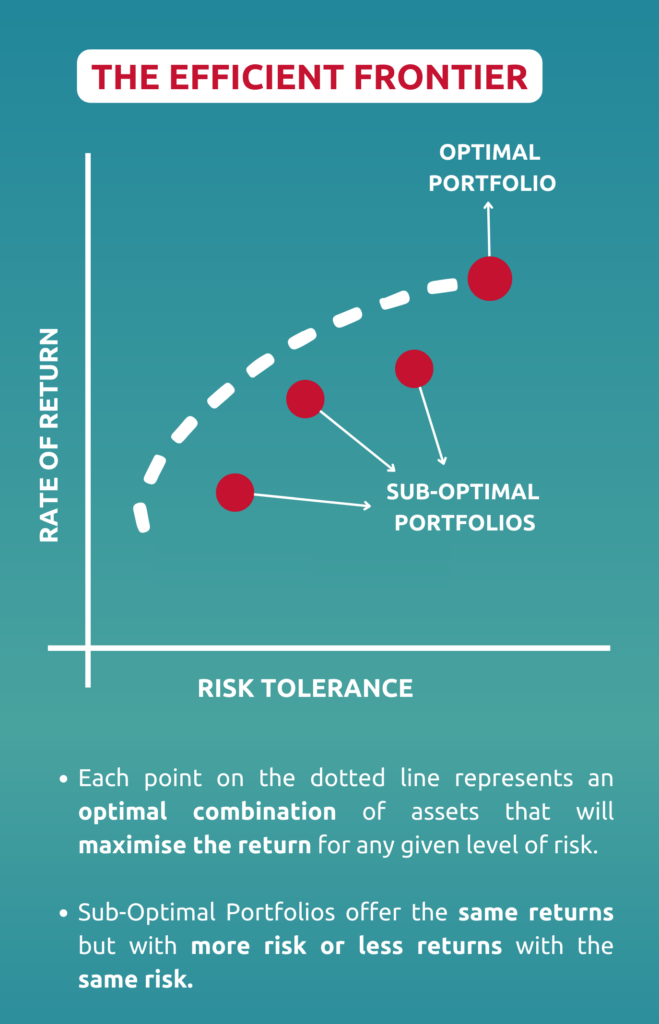
On a graph, the efficient frontier is a curved line where each point represents a portfolio with the lowest risk for a certain expected return. Portfolios below this line are not ideal because you can get a better return for the same risk or a lower risk for the same return by choosing a portfolio on the frontier.
So, the efficient frontier guides investors to pick portfolios that give them the best possible trade-off between risk and reward.
Read more on KDI.
To Code or Not to Code, Revisited
Posted: February 9, 2025 Filed under: Uncategorized Comments Off on To Code or Not to Code, RevisitedSo, I ranted about code in static papers a while back (someone asked me about this – so I’d figure allow me to do a follow up), but what if your code is the real star of the show? Can you still sneak some in without drowning readers in curly braces?
Yes.
If your snippets are absolutely critical—like the secret sauce that everyone needs to see—fine, slip in a few lines. Just make them short and sweet. No one wants to navigate a labyrinth of semicolons; your readers only care about that one essential function or loop that proves your point. But don’t stop there: you still need to explain why those lines matter. If you’re showing off a special parsing trick or a brand-new algorithm, tell us why it’s special—don’t just paste it and pray.
Most importantly, provide a link to the full code in its natural habitat, whether that’s GitHub or another platform. Readers who truly want to dig deeper will thank you for letting them see—and run—the real thing, rather than forcing them to squint at a crammed PDF. Give context, give clarity, and keep the clutter to a minimum. After all, no one’s going to appreciate a code dump… not even your future self re-reading that paper.
Keep it stupid simple. KISS.
Technology should serve people, not the other way around
Posted: September 25, 2021 Filed under: Uncategorized Comments Off on Technology should serve people, not the other way aroundThis essay is a repost from a Medium story.
I’ve known computers since I was about 5 or 6. It was the year 1995. My father’s workplace was the only place I could see computers at the time. Paperboy, Prince of Persia, and Oregon Trail were among the MS-DOS games he introduced me to. But it wasn’t the games or interactive graphics that drew me in, but rather the machine itself. I recall being enthralled by Windows. I’m fascinated by how it looked, how it worked, and the simple yet effective applications it contained. In 1998, we finally got our own computer with a dial-up internet connection.
For me, the computer was my only means of self-expression. With text, images, and sounds, I could create whatever I wanted. With audio files like .mp3 and .wav, as well as video files like Quicktime and Windows Media, I could listen to whatever music I wanted. mIRC was the only way I could communicate with people from all over the world. Even if they were in another country, I was able to share my thoughts and opinions with them. I didn’t have many friends in school back then because I preferred interacting with the keyboard.
The internet and technology have become obsessions for us. PCs, mobile phones, laptops, and smart devices have exploded in popularity over the last two or three decades. From the classroom to the bedroom, the internet had spread. We spend the majority of our time in front of a computer or on a mobile device. The majority of people spend far more time in front of a screen than they do outdoors.
True, technology is altering our lifestyles, but it also requires us to alter our lifestyles. It’s exhausting to be told that technology is working for us, not against us, all of the time. It’s all too easy to fall into this mindset and fail to recognise that it’s illogical.
We worship technology so much that we sometimes lose sight of its purpose. What can technology help me with? Is it possible for it to assist me in expressing myself more effectively? Is it capable of assisting me in interacting with people I have never met before anywhere in the world? Is it possible for technology to manipulate, control, and shape people’s lives? Yes, that is correct.
We are the product in the economy of attention. We are the resource that technology is consuming. By using technology such as the internet, we are giving up our privacy and freedom. Technology is working for us rather than against us. With each passing year, it gains more and more control over our lives, but we are completely unaware of it.
We are distracted from what we are doing right now by notifications, apps, and alerts on our mobile devices and computers. These are meant to draw our attention away from the rest of the world. Our focus is broken down into very small chunks. On our mobile devices and computers, we divide our attention between various notifications, apps, and alerts, or even multiples of each. Finally, being online has become an obsession for us. We just can’t seem to stop ourselves. We now try to avoid interacting with people in real life as much as possible.
And we don’t realise how much of our attention and technology we give away until we lose something. One of the most prominent examples is social media. We quickly share the most memorable events in our lives with others. That is, after all, what it is supposed to be. Some people, on the other hand, only share their happiest moments online in order to make others believe they are doing well.
We should not be defined by technology, but rather by how we use it and what we can accomplish with it. To put it another way, technology must be centred on humans rather than the other way around.
Allow yourself to be free.

Thintelligence
Posted: May 14, 2017 Filed under: Uncategorized Comments Off on ThintelligenceThe state of mind where a person does something without considering the consequences. The idea may seem brilliant at first, but the after-affects usually prove to be deadly. This phrase was invented by Michael Crichton in his book Jurassic Park (the character Malcolm says it)
Time versus word count
Posted: February 1, 2017 Filed under: Uncategorized Comments Off on Time versus word count
Perseverance test – Surgeon Tryouts
Posted: April 25, 2016 Filed under: Uncategorized | Tags: video Comments Off on Perseverance test – Surgeon TryoutsMicro Origami, Sushi and Insects. That is an insane way to test perseverance and a steady hand. Only in Japan.
The brain’s chemical
Posted: April 25, 2016 Filed under: Uncategorized | Tags: bliss, brain, chemical, dope, hormone Comments Off on The brain’s chemicalDopamine
Dopamine is the motivation chemical. It increases engagement, excitement, creativity and the desire to reach out and make meaning out of the world.
This dope chemical accelerates exploration. When crossed anything refreshing and unusual, we get excited and immediate response comes out; that’s dope yaw! That’s similar with Dopamine. When the brain secretes an optimum amount of dopiness, it accelerates pattern recognition (data processing) to able to absorb information faster.
Norepinephrine
Norepinephrine is the organic agent that secreted by the medulla of the adrenal glands to develops attention, neural efficiency and emotional adjustment. This flow agent is tightening focus (data acquisition) and good for productivity. It also referred as the stress hormone.
Intense emotions such as fear or anger cause epinephrine to be released into the bloodstream, which causes an increase in heart rate, muscle strength, blood pressure, and glucose metabolism.
Endorphin
Endorphin ignites determination. It also opiates relieves pain and produce pleasure, like heroin. The most natural endorphin amount is one hundred times stronger than clinical morphine.
Endorphin also evolved during survival. The same chemical switch on-off so we don’t ended up walking on the broken leg. Also promoting wellbeing and emotion; happiness and sadness.
Anandamide
Anandamide in the other hand; elevates mood, relieve pain, dilates blood vessels and amplifies our lateral thinking. More critically, it also inhibits our ability to feel fear, facilitates the extinction of long-term fear memories. An optimal body and mind have the right amount of anandamide; makes memory retrieval faster by widens the database search.
Serotonin
Serotonin is the safety and respect chemical. This agent accommodating people to cope with adversity. In productivity and intense focus, this element comes later after the flow state. It delivers an after-glow effect and give a feel good sensation after coming to end, and not at the beginning.
In a mammal, serotonin is discharged when it recognizes it’s bigger or stronger than another; having the edge creates a sense of security.
Oxytocin
Oxytocin is the bonding chemical. It promotes trust and sense of belonging. In made in the hypothalamus, of the brain.
It has been named as the hug hormone, cuddle chemical, moral molecule, and the bliss hormone due to its effects on behavior, incorporating its character in admiration as well as affection, and has prominent reproductive biological functions in reproduction.
Unofficial biography of Elon Musk
Posted: April 22, 2016 Filed under: Personal, Uncategorized | Tags: book, review Comments Off on Unofficial biography of Elon MuskThe only reason why I’d drill into this book was because of critics of this biography, not because Elon Musk himself. This biography has in-depth self-centered insights and viewfinder by the author, Ashlee Vance. I kept my prejudice move along as I seek what was not right with the subject. I put the little interest of his back stories since I read/watch plenty of number about Musk somewhere else.

Through author’s extensive conversations with Musk himself, his close associates, opponents and others who have personally worked encompassing him, the author constructs a never seen before look at how Musk operates. The theme, however, is lacking authority, it is unlikely to tell what’s genuine and what is merely the author’s opinion.
Elon Musk is a highly dedicated entrepreneur. This biography, however, seems will be a backfired by Pro-Musk. It is latter to know from another perspective. I walked out with lesser respect for Musk. However, I keep that hang for awhile and wait for the autobiography of himself.